
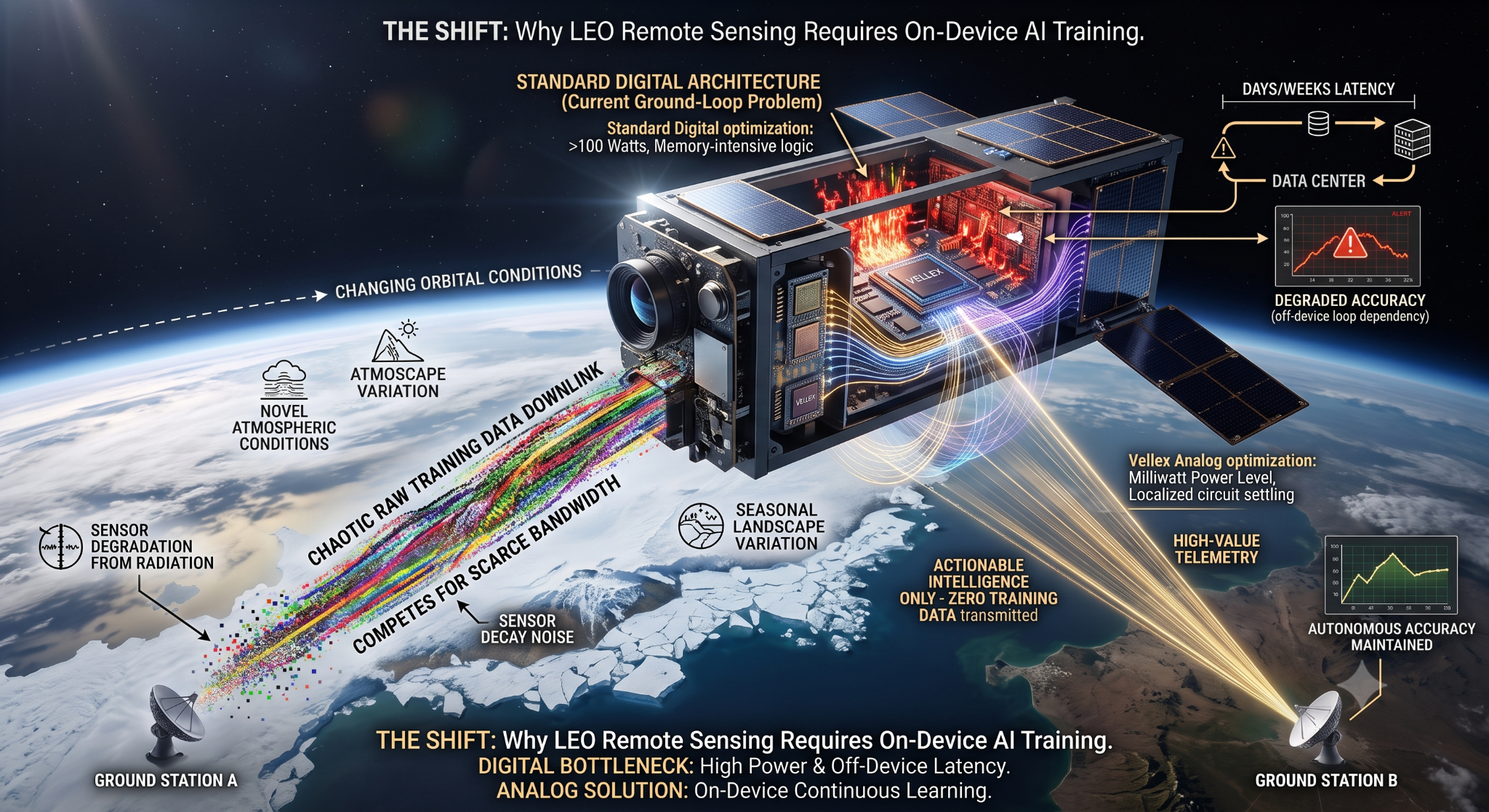
Earth observation satellites and orbital remote sensing platforms generate high volumes of high-resolution data. To process imagery and telemetry on-orbit, these systems run AI inference locally, using pre-trained, fixed-weight models to identify targets, filter cloud cover, and compress data before transmitting it to the ground.
The physical environment of low Earth orbit keeps changing, and static models degrade as a result. Satellites encounter novel atmospheric conditions and seasonal variation in the landscapes they image. The hardware itself also changes: optical sensors and hyperspectral imagers suffer gradual degradation from cosmic radiation and thermal cycling. When live data diverges from the dataset used to train the original model, accuracy drops. Engineers call this model drift. Restoring accuracy requires updating the neural network parameters, and current computing architectures force that process off-device.
To fix model drift, operators rely on a ground-based retraining loop. The satellite transmits raw mission data to a ground station, engineering teams retrain the model in a data center, and the updated parameters are uplinked back to the satellite.
This cycle competes directly with the satellite's primary mission. Low Earth orbit platforms generate terabytes of data daily. Downlink bandwidth is a strictly limited resource, restricted to brief windows when the satellite passes over a compatible ground station. Transmitting raw training data, which often consists of noise, atmospheric interference, and unusable imagery, consumes the same bandwidth allocated for actionable intelligence. Every megabyte of raw training data sent down is a megabyte of revenue-generating telemetry lost.
Latency compounds this bottleneck. Ground station passes are brief, typically five to ten minutes per orbit, and coverage is intermittent. The round-trip from a viable connection to downloaded data to data center retraining to uplinked model takes days or weeks. During that window, the satellite continues operating with degraded analytical capabilities, making time-sensitive intelligence unreliable.
Running the training process directly on the satellite eliminates the downlink bottleneck. The physical barrier is payload power.
Standard digital processors execute AI training through continuous data movement between memory and compute cores, calculating gradients over millions of discrete clock cycles. This architecture draws tens to hundreds of watts for training workloads.
Small satellites operate on constrained solar and battery power budgets, often limiting total payload compute to a few dozen watts. Allocating that budget to a digital training workload would require shutting down primary sensors or propulsion systems. This power constraint is what keeps AI training on the ground.
Operating on-device eliminates the data downlink requirement for model updates. Raw telemetry and imagery stay on the satellite. A system equipped to train locally discards environmental noise and uses its limited downlink bandwidth exclusively for high-value intelligence. Onboard models update as the hardware encounters novel atmospheric conditions, sensor degradation, or shifting target profiles, without waiting for a ground station pass and without depending on an intermittent communication link.
The true cost of ground-based retraining is the operational dependency it creates. Every orbital system that relies on data center retraining inherits the connectivity, latency, and data pipeline limitations of that architecture.
Vellex builds analog compute hardware that runs AI training directly on-device. The approach maps optimization mathematics onto analog circuits, which settle to a solution through circuit dynamics rather than iterating through millions of discrete digital steps. The result is AI training at milliwatt power levels, compatible with the strict power budgets of orbital payloads.
By keeping training on the satellite, Vellex-equipped systems maintain model accuracy autonomously as conditions change, without consuming downlink bandwidth for raw training data or requiring ground-based engineering cycles to push updates.
READ MORE


