
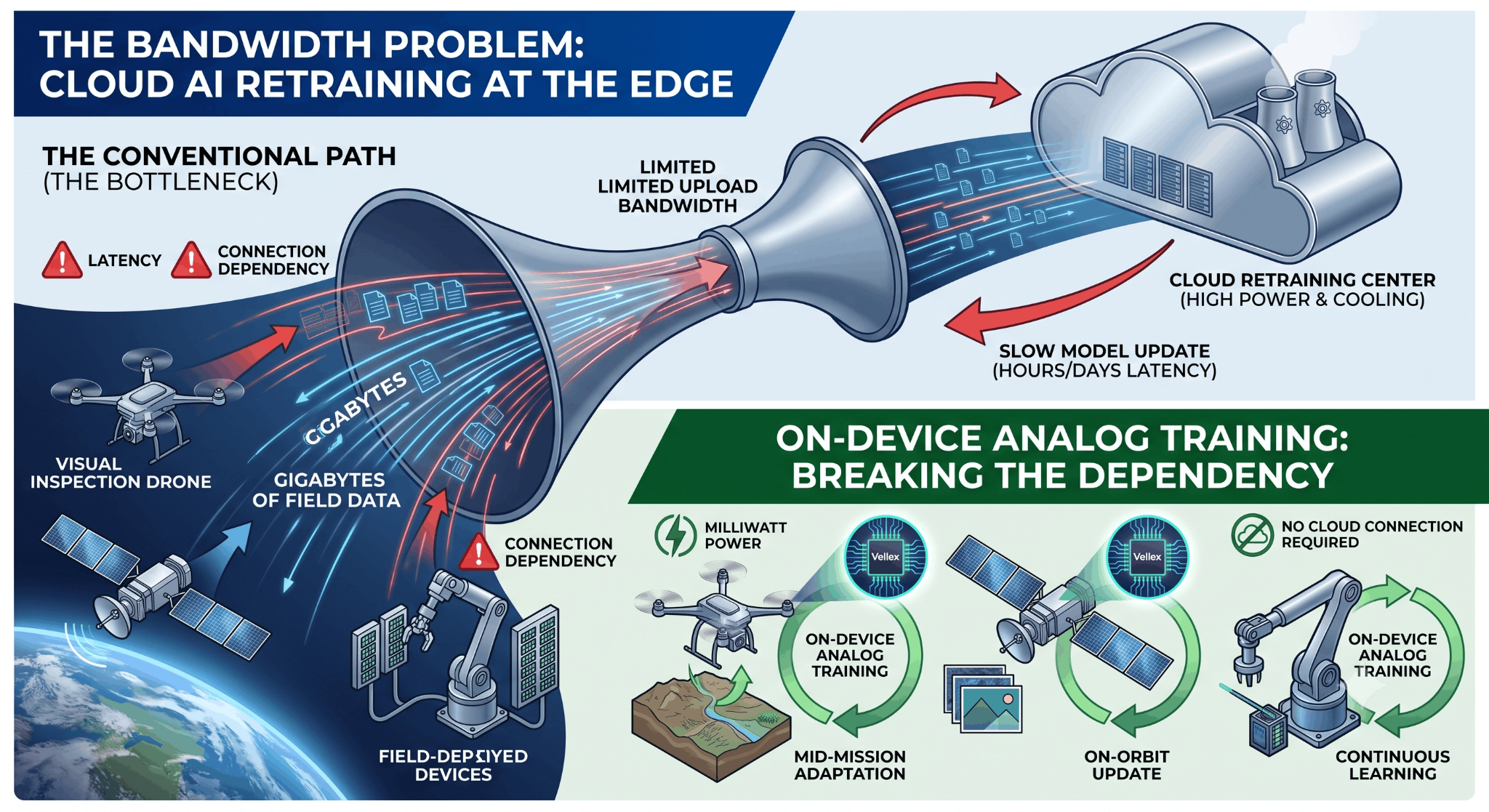
AI models deployed in the field, on drones, satellites, and industrial systems, are trained in data centers and then shipped to the hardware they run on. For as long as field conditions match training conditions, this works. When they diverge, the model needs to be updated. The conventional path is to send field data back to the cloud, retrain, and push a new model to the device.
This update cycle has a cost that goes beyond compute time and cloud spend. It requires field hardware to maintain a reliable data pipeline to remote infrastructure, at volumes and frequencies that the available connectivity infrastructure often cannot support. And because training stays locked in the cloud, deployed systems cannot adapt without it.
The energy and thermal requirements of AI training are the physical reason it has not moved to the edge. Purpose-built AI accelerators, the chips that now run most large-scale training workloads, draw hundreds of watts per device during active training. A single rack of these accelerators requires kilowatts of sustained power and generates concentrated heat that air cooling cannot manage. Data centers deploy industrial liquid cooling infrastructure to maintain safe operating temperatures, adding significant water and electrical overhead on top of the compute itself.
Edge devices operate at an entirely different scale. A battery-powered drone, satellite, or industrial sensor draws milliwatts to low watts in total. The gap between what field hardware can provide and what digital training requires is several orders of magnitude. No software optimization or model compression closes that gap. It is a physical constraint, and it is why training has remained centralized.
Even setting aside power, the data pipeline required for cloud retraining presents its own barriers.
Cloud retraining starts with uploading field data. A drone running visual inspection generates multiple gigabytes of raw sensor and camera data per mission. An industrial sensor array monitoring a manufacturing process can produce terabytes per day. A satellite imaging platform captures large volumes of raw data before any filtering or compression is applied. Sending this to a remote server for training is not a matter of flipping a switch.
High-bandwidth satellite connectivity solutions like Starlink have expanded what is possible in remote environments, but they have real limits. Upload throughput is typically in the range of tens of megabytes per second under good conditions. In polar regions, over open ocean, or in contested environments, coverage is intermittent and cannot be assumed. For a drone generating several gigabytes of mission data, a full upload could take longer than the mission itself. For a satellite, transmitting raw training data to a ground station competes with the downlink bandwidth already consumed by the operational data the satellite exists to collect.
Beyond throughput, there is latency. The round-trip from data upload to completed retraining to updated model back on device is measured in hours to days, not seconds. For systems operating in environments where conditions change faster than that cycle can respond, this lag directly limits what the hardware can do.
The connectivity assumption embedded in cloud retraining, that field devices have reliable, high-bandwidth access to remote infrastructure, does not hold for the environments where continuous AI adaptation matters most.
When a deployed model cannot be updated without a cloud connection, every change in field conditions degrades performance until the next retraining cycle completes. A drone operating in terrain that differs from its training data, a satellite imaging through atmospheric conditions it has not seen, an industrial robot encountering a new operating environment: all of these are cases where model accuracy drops and the system cannot correct itself. Model drift is gradual but cumulative, and in safety-critical applications, a model that has not been updated for weeks operates at an unknown and decreasing level of reliability. For systems deployed in remote, mobile, or contested environments, this is not a minor inconvenience. It is a structural limitation on what the hardware can reliably do.
Vellex builds analog semiconductor chips that run AI training directly on-device. The approach maps optimization mathematics onto analog circuits, which settle to a solution through physical dynamics rather than iterating through discrete digital steps. The result is AI training that operates at milliwatt power levels, compatible with battery-powered hardware, with no cloud connectivity required.
Without a training pipeline to the cloud, there is no data upload requirement. Field data stays on the device. Models update as the hardware encounters new conditions, without waiting for a retraining cycle to complete and without depending on a connection that may not be available.
The practical impact is clearest in the systems where these constraints are most acute. Autonomous drones can adapt their navigation and inspection models mid-mission based on what they actually encounter in the field. Satellite systems can update imaging and signal-processing algorithms on-orbit, without competing for downlink bandwidth to send training data to the ground. Industrial IoT deployments can retrain predictive maintenance models continuously from live sensor data, without transmitting that data off-site or waiting for a scheduled cloud update.
The cost of cloud AI training is not primarily the electricity bill or the data center overhead. It is the operational dependency it creates. Every system that relies on cloud retraining inherits the connectivity, latency, and data pipeline requirements of that architecture. In the environments where field-deployed AI is most valuable, those requirements are the hardest to meet. On-device training does not work around this dependency. It removes it.
READ MORE


