Analog vs. Digital: The Ultimate Guide to Choosing the Right Tech
Vedant Wakchaware
June 18, 2026
•
5 min read
1. Introduction Every smartphone, computer, and smart gadget you own is constantly processing a massive ocean of data. But behind the sleek screens and apps lies a fundamental battle over how this information is actually handled.
For decades, engineers have debated the best way to process data: Analog vs. Digital. One offers a perfect, high-fidelity copy of reality but is prone to static. The other offers perfect reliability but drains massive amounts of electricity.
As we push the limits of modern technology—trying to build smarter AI and longer-lasting batteries—understanding this divide is more important than ever. Today, we are going to break down exactly how both systems work, their pros and cons, and why the ultimate solution might just be combining them together.
2. Analog: Basics, Advantages, and Disadvantages
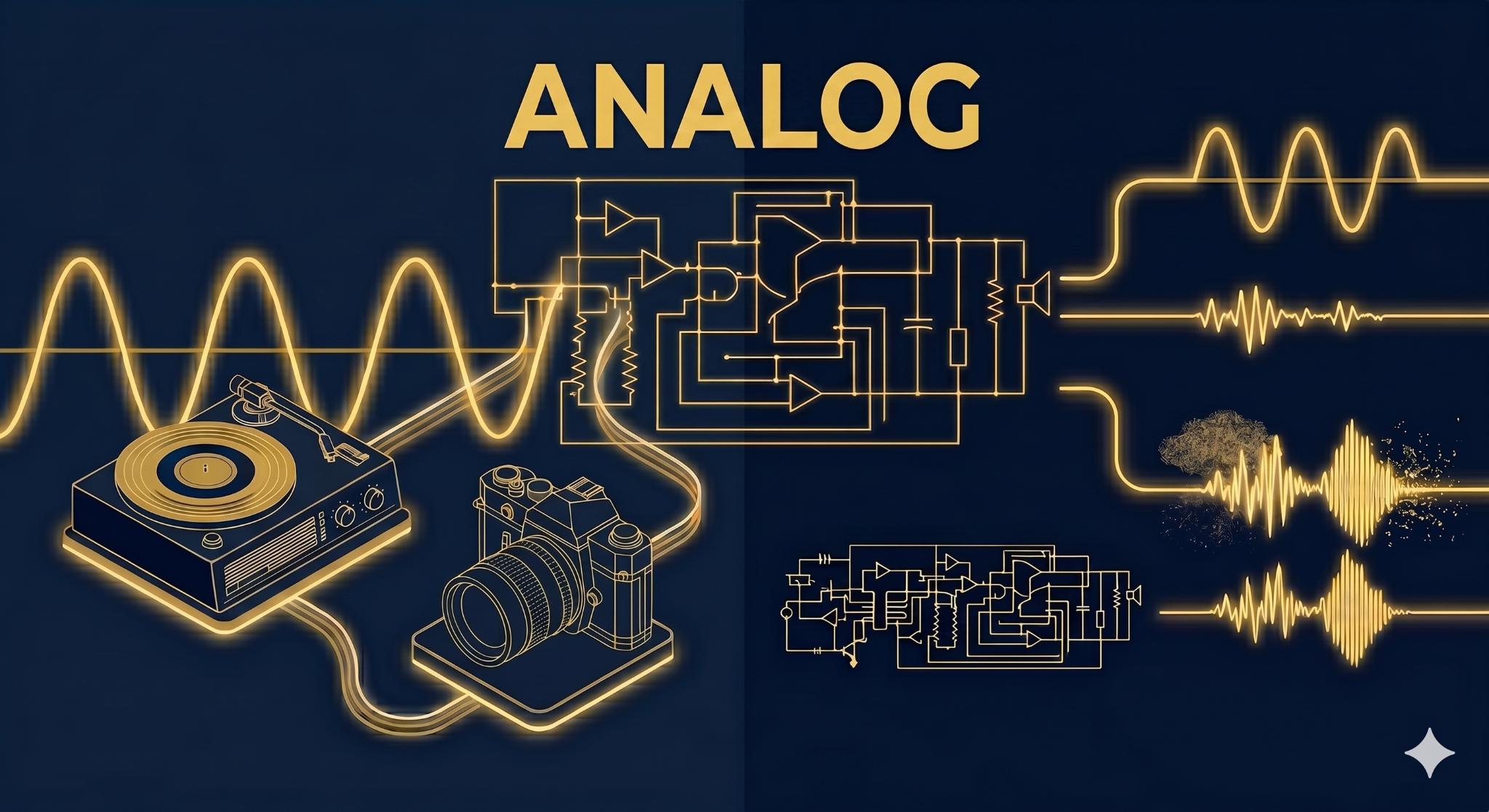
Basics: Analog systems represent information as a fluid, continuous wave. Imagine a perfectly smooth wheelchair ramp; you can stand at any exact, infinite point along that slope. When you speak into a microphone, your voice creates a continuous analog wave.
Advantages:
Extreme Energy Efficiency: Analog circuits exploit the natural physics of electricity to do math instantly. It requires very few components, making it incredibly power-efficient.
Infinite Resolution: Because the signal is a continuous wave, it captures every microscopic detail of the real world without rounding numbers. This creates high-fidelity, true-to-life data (like the warm sound of a vinyl record).
Disadvantages:
The Noise Trap: Analog is highly sensitive to background static. Every time a signal is passed to a new component, it picks up a tiny bit of interference (like a giant game of "Telephone"). Over time, this noise accumulates and ruins the signal.
Difficult Circuit Design (The "Art Form"): Designing an analog circuit diagram is incredibly complex. Because it relies directly on the raw physical properties of electricity (like exact voltages and currents), creating and tuning these circuits is highly sensitive and requires specialized knowledge. It's often considered an "art form" that is very difficult to automate with software.
Degradation: You cannot copy analog data perfectly. Every copy loses a little bit of quality.
3. Digital: Basics, Advantages, and Disadvantages
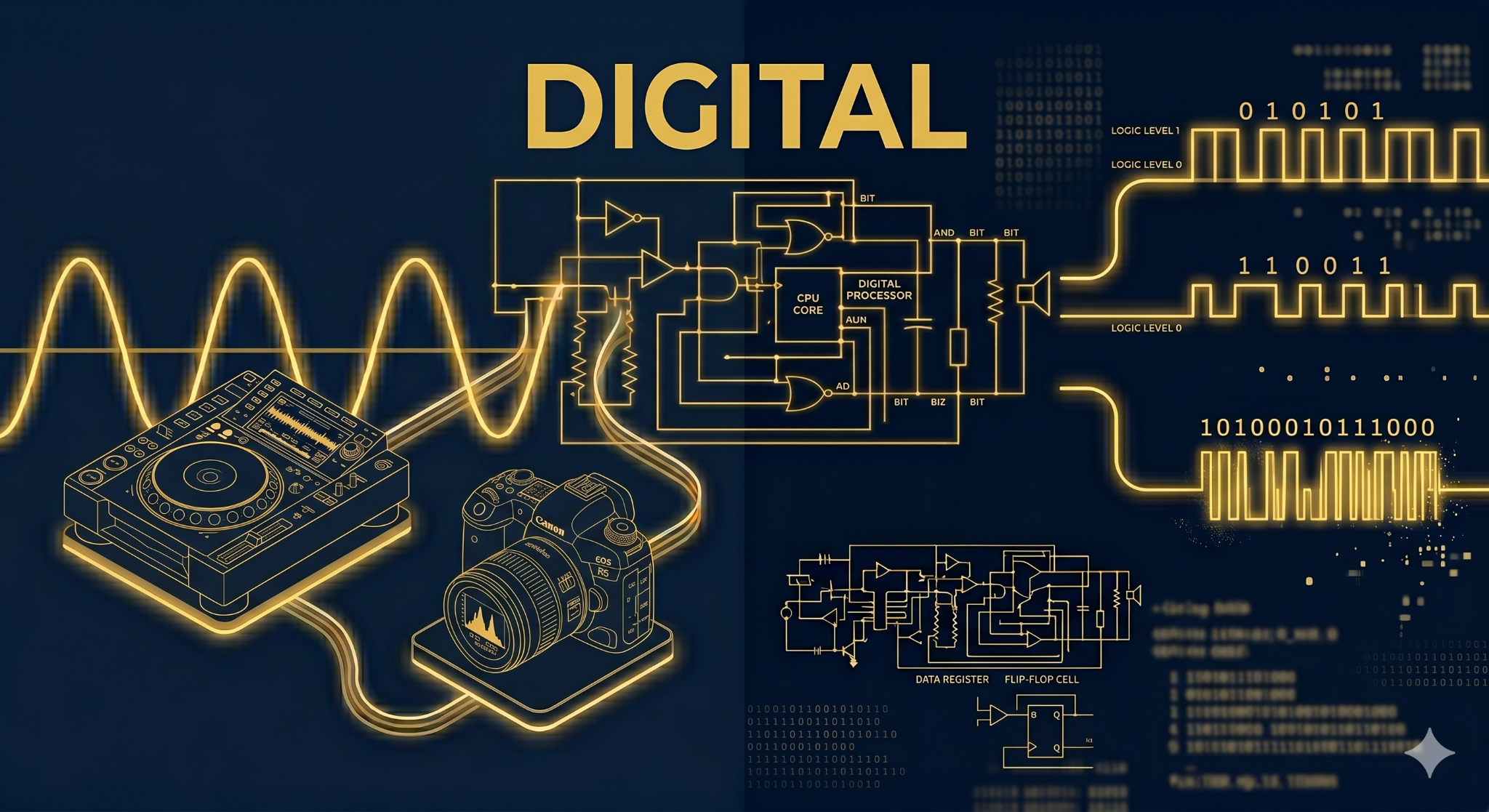
Basics: Digital systems represent information in rigid, discrete steps. Think of a staircase instead of a ramp. You can only stand on a specific step (1 or 0), never floating in between.
Advantages:
Perfect Noise Immunity: If a gust of static hits a digital signal, the system easily ignores it because it just rounds the value back to the nearest rigid step.
Flawless Copying and Storage: Because digital data is just numbers, you can copy a file a million times, and the millionth copy will be identical to the first. It is perfect for the internet and data storage.
Easier Circuit Design (The "Science"): Unlike analog, designing digital circuit diagrams is highly standardized. Because it relies on basic, universal logic gates (like AND, OR, NOT), the design process is an exact science. It is much easier to design, test, and completely automate using computer software.
Ultimate Flexibility: Digital hardware is programmable. You can change what a digital chip does simply by downloading a software update.
Disadvantages:
Massive Power Consumption: To do the exact same math as a simple analog circuit, a digital processor has to physically flip thousands of microscopic transistors on and off. This generates immense heat and violently drains batteries.
Approximation Errors: Digital systems are technically just imitations of reality. Forcing a smooth wave onto a rigid staircase creates tiny rounding errors (quantization errors).
4. The Hybrid Approach: Combining Both Together
If digital takes too much power, and analog drowns in static, how do we solve the hardware dilemma?
We build a Hybrid System (often called an A/D/A or Analog/Digital/Analog loop).
The Basics: Instead of forcing a computer to be 100% one or the other, it alternates between them to get the best of both worlds.
Advantages: The Best of Both Worlds: The system uses ultra-efficient analog circuits to do the heavy processing (saving massive amounts of battery). Then, before the analog "static" can build up, it passes the signal through a quick digital checkpoint. This digital step acts like a filter, cleaning up the noise and restoring the signal to perfection before sending it back to the analog processor.
Ultra-Low Power: It allows devices to perform complex AI tasks without needing to be plugged into a wall outlet.
Disadvantages:
High Complexity: Designing a system that constantly translates between analog waves and digital steps requires highly specialized, complex hardware (Converters) and brilliant engineering.
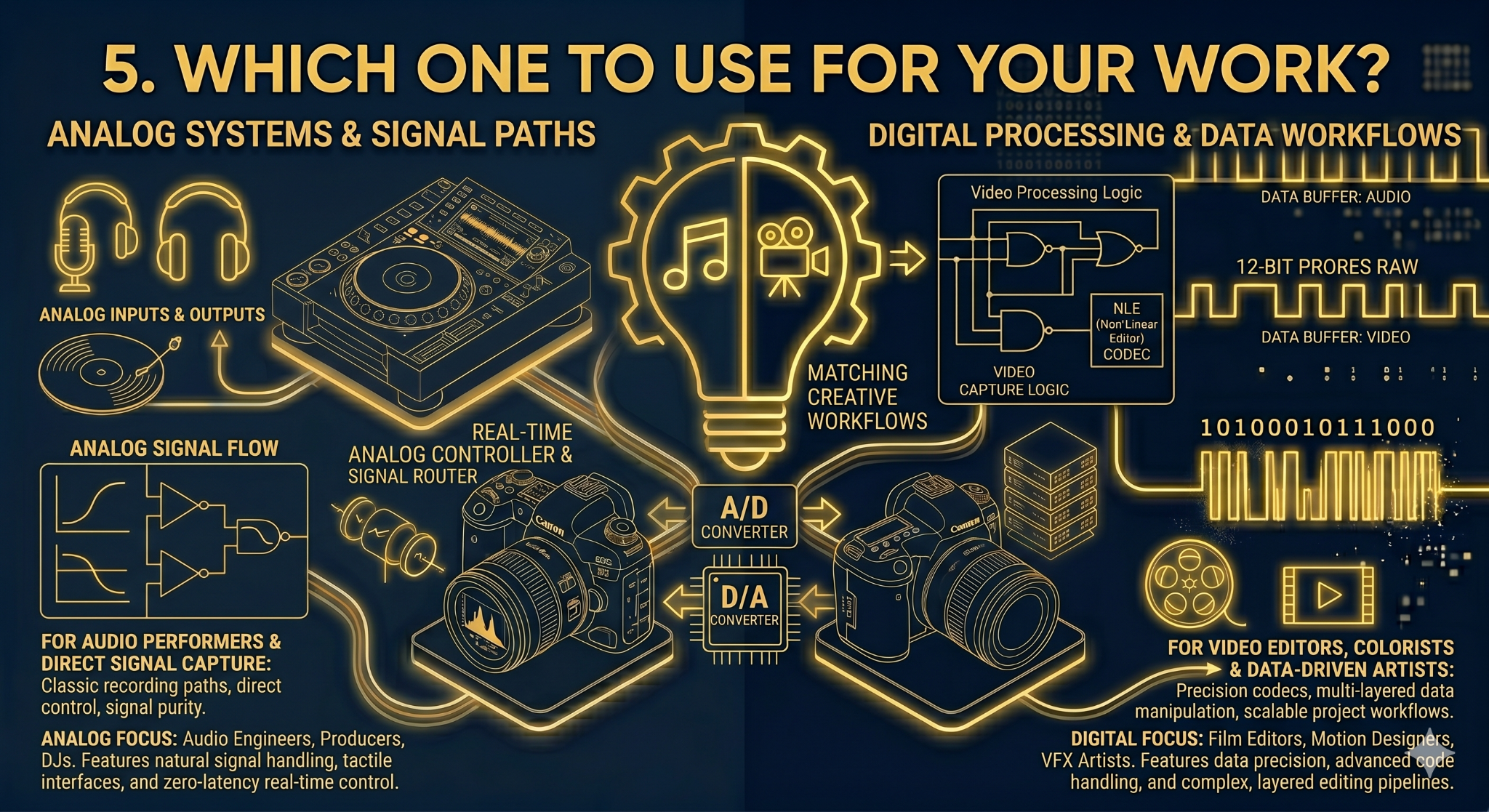
5. Which One to Use for Your Work?
Choosing the right technology depends entirely on what you are trying to build. There is no one-size-fits-all answer, so here is a detailed breakdown of how to pick the right tool for your specific industry:
Choose Analog if you work in: Professional audio engineering, sensitive scientific measurement, real-time radio frequency (RF) transmission, or neuromorphic engineering (brain-inspired computing).
Why it works: These fields deal with the physical world in its rawest form. If you are recording a live symphony, tracking slight temperature shifts in a lab, or building radar systems, you cannot afford the "rounding errors" or micro-delays (latency) caused by digital conversion. Neuromorphic chips use raw physics to mimic the brain's analog efficiency for ultra-low-power processing.
The Ultimate Benefit: You get the purest, most detailed representation of the physical world with absolute zero lag, unmatched energy efficiency for specialized calculations, and infinite resolution.
Choose Digital if you work in: Software development, IT infrastructure, finance, cybersecurity, big data analytics, or e-commerce.
Why it works: These fields require absolute precision in data retention and transfer. If you are building a banking app, a global database, or encrypting secure data, you need to know that a "1" stays a "1" forever. Digital systems allow you to use standard programming languages to build complex logic that scales effortlessly across millions of devices without degrading.
The Ultimate Benefit: You get absolute data integrity, flawless storage, easy-to-update software programming, and the ability to scale complex algorithms across global server networks.
Choose Hybrid if you work in: IoT (Internet of Things), autonomous vehicles (self-driving cars), 5G/6G telecommunications, battery-powered smart sensors, or advanced robotics.
Why it works: These cutting-edge fields face a unique challenge: they must read an unpredictable, continuous physical world, but apply rigid, highly reliable rules to it. A self-driving car needs analog sensors (LiDAR, radar, cameras) to constantly read the street on almost zero lag, but it needs digital processors to apply rules, recognize stop signs, and navigate safely.
The Ultimate Benefit: You can instantly translate real-world chaos into actionable, highly reliable digital logic. It bridges the gap between the physical environment and artificial intelligence while keeping devices incredibly smart, responsive, and battery-efficient.
6. The Future of Technology
For decades, the tech industry has been obsessed with brute force—building faster, denser, and hotter purely digital chips. But as data volumes explode and AI becomes a part of everyday life, we are hitting a physical wall. We simply cannot generate enough electricity to power a purely digital future.
The future of advanced hardware won't be found just by shrinking digital transistors. It lies in distributed, hybrid mixed-signal architectures. By moving back toward analog efficiency, guided by digital reliability, hardware engineers are unlocking the next generation of smart technology that can run anywhere, at any time, on almost zero power.
7. Frequently Asked Questions (FAQs)
What is the main difference between analog and digital signals? Analog signals are fluid and continuous (like a smooth ramp), allowing for infinite detail. Digital signals are discrete and rigid (like a staircase), allowing for perfect, error-free copying.
Why do digital processors consume so much battery power? Digital systems rely on billions of microscopic switches (transistors) to perform calculations. Every time a calculation is made, these switches must physically flip on and off, which requires significant electricity and generates heat.
Which circuit is harder to design? Analog circuits are generally much harder to design. They rely on the physical properties of electricity and are so sensitive that designing them is considered an "art form." Digital circuits are based on standardized logic gates, making them much easier to design and automate with software.
What is the "Noise Trap" in analog circuits? Because analog signals are continuous, they easily pick up electrical interference from the physical environment. Every time the signal passes to a new component, more static is added. Eventually, this noise accumulates and drowns out the actual data.
What is a Hybrid (A/D/A) system? It is a system that uses analog circuits to process data incredibly efficiently, but periodically passes the signal through a digital checkpoint. This cleans up any accumulated noise before converting the signal back to analog to continue processing.
Autonomous drones rely on pre-trained AI models to navigate and inspect infrastructure, but these static models fail when field conditions diverge from training data. The traditional fix requires transmitting raw sensor data back to a remote server, consuming critical bandwidth and creating crippling latency. This article explores how the high power requirements of digital processors keep AI retraining locked in data centers, and how Vellex Computing uses milliwatt-level analog hardware to move the retraining process directly onto the drone, ensuring continuous adaptation in remote and contested environments.
Earth observation satellites rely on pre-trained AI models to process massive volumes of imagery on-orbit, but these static models degrade as hardware decays and atmospheric conditions change. The traditional fix requires transmitting gigabytes of raw training data back to Earth, consuming the limited downlink bandwidth meant for high-value intelligence. This article explores how the power constraints of digital processors keep AI retraining locked in data centers, and how Vellex Computing uses milliwatt-level analog circuits to move the retraining process directly onto the satellite, ensuring autonomous adaptation without the downlink bottleneck.
When field-deployed AI models encounter unexpected conditions, they degrade. The traditional fix relies on sending massive amounts of raw data back to the cloud for retraining. This article explores the severe connectivity constraints—from limited bandwidth to crippling latency—that make cloud dependency a critical flaw for edge devices. Discover how Vellex Computing eliminates this bottleneck entirely by using analog semiconductors to train models directly on-device, enabling continuous, real-time adaptation for drones, satellites, and industrial IoT without requiring an internet connection.

.png)