October 8, 2025

Why the Future of High-Performance Computing Is Analog

For decades, progress in computing has been synonymous with digital scaling - faster transistors, denser chips, more powerful clusters. But as AI workloads surge, this once-reliable trajectory is colliding with the limits of physics and energy.
The next frontier in performance will not come from squeezing more logic into silicon - it will come from computing with physics itself.

Analog computing represents that shift. It’s not just a faster engine; it’s a fundamentally more efficient model of computation - one that aligns with the physical realities of both data and energy.

The AI–HPC Energy Wall

Artificial Intelligence is now one of the largest consumers of compute resources in human history.
Training state-of-the-art models has become a power-intensive industrial process, rivaling small nations in electricity use.

  • Training GPT-4–scale models is estimated to consume over 1,000 MWh of energy - the equivalent of powering 1000 average homes for a year.
  • Data centers already account for 3–4% of global electricity consumption, and the IEA projects a 2× increase by 2030 driven primarily by AI workloads.
  • The cost of training frontier models has soared beyond tens of millions of dollars, with energy use now a first-order design constraint.

The result: a compute-energy-carbon bottleneck that threatens both the economics and sustainability of innovation.

The Compute–Energy–Carbon Triangle

In the digital era, performance has traditionally been defined by FLOPS — raw computational throughput.
But for modern AI and HPC, that metric has become incomplete. The true measure of performance now exists within what can be called the Compute–Energy–Carbon Triangle:

Dimension Description Challenge
Compute How much processing can be achieved AI demands 10× growth annually
Energy Power consumed per operation Energy efficiency improvements have stalled
Carbon Environmental cost of compute Rising regulatory and ESG scrutiny

Current HPC systems optimize primarily for compute, often at the expense of energy and carbon efficiency.
Yet each dimension is now economically linked: higher compute → higher power → higher cost and carbon liability.

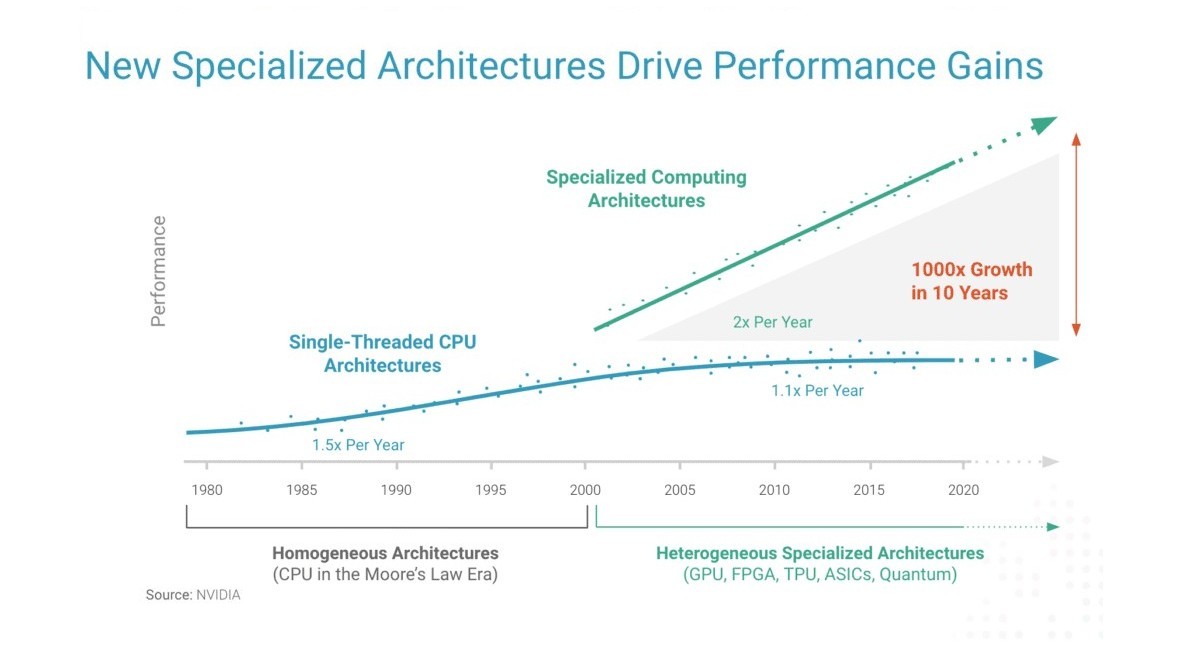
Digital Scaling Has Plateaued

The digital world is built on a simple promise - every two years, chips get smaller, faster, and cheaper.
That promise has broken down.

Moore’s Law and Dennard Scaling - the dual engines of progress for 50 years - have effectively plateaued:

  1. Transistor miniaturization below 3nm yields diminishing returns in energy efficiency.
  2. The energy cost of data movement now dominates total power -moving bits between memory and processors consumes 100× more energy than performing arithmetic.
  3. In large-scale AI systems, up to 80% of total energy is wasted on data transfers rather than computation itself.

In essence, we are burning vast amounts of energy to move zeros and ones around.

The architecture of modern HPC rooted in von Neumann’s separation of memory and compute is becoming an energetic liability.
It’s a 20th-century design being pushed to its 21st-century limits.

Analog Computing: A Paradigm Aligned with Physics

Analog computing challenges that architecture entirely.
Instead of abstracting away physics, it computes with it.

Where digital processors represent information as discrete bits, analog systems represent and manipulate continuous quantities — voltages, currents, or waveforms — that inherently model real-world dynamics.

This leads to three defining advantages:

  1. Compute Where Data Lives:
    Analog systems enable in-memory or in-sensor computation, eliminating the massive energy cost of data movement.
    Result: up to 1,000× reduction in energy spent on I/O.
  2. Native Parallelism:
    Physical systems evolve in parallel. Analog arrays can solve large-scale optimization or simulation problems orders of magnitude faster than serial digital logic.
    Result: sub-millisecond solutions to problems that take hours on CPUs or GPUs.
  3. Power Efficiency Rooted in Physics:
    Since analog operations leverage continuous physical processes rather than discrete switching, they consume up to 100× less power per operation.

The outcome is not just faster computing, it’s computing with radically higher energy proportionality.
You get performance that scales with physics, not against it.

The Strategic Implications for Business and Infrastructure

For enterprises and governments betting their future on AI, HPC is no longer a back-end utility — it’s a core strategic asset.
But the economics of that asset are changing fast.

Leverage Point Analog Advantage
Cost Efficiency 10–100× lower cost per computation due to energy reduction
Sustainability 90% lower power footprint per AI workload, cutting CO₂ emissions proportionally
Latency Real-time decision-making on the edge — critical for autonomous systems, defense, and robotics
Scalability Breaks power-density limits of digital data centers

The financial logic is straightforward: when power defines cost, efficiency defines advantage.
Analog computing redefines the compute cost curve, transforming energy from a constraint into a competitive differentiator.

Hybrid HPC: The Road Ahead

Analog will not replace digital; it will redefine its boundaries.
The future of high-performance computing is hybrid - a stack where digital logic ensures precision, and analog accelerators deliver efficiency for continuous, physics-heavy workloads such as:

  • Optimization and simulation
  • Signal and sensor processing
  • Neural network inference
  • Edge decision systems

Such architectures could cut AI training energy by 100× and reduce inference costs by 90%, making intelligence not just faster but economically and environmentally sustainable.

This convergence -HPC, AI, and analog - will mark the most profound transformation in computation since the advent of silicon itself.

The New Measure of Performance

In the coming decade, the world will no longer measure supercomputers solely in FLOPS.
We’ll measure them in efficiency per watt how intelligently they convert energy into insight.

Analog computing is uniquely positioned to lead that transition. It aligns with both the physics of computation and the economics of sustainability.
For business leaders, embracing it early is not just a technological choice, it’s a strategic hedge against the rising cost of intelligence.

In short:

The future of high-performance computing won’t be built by pushing electrons faster through digital gates.
It will be built by computing directly with the laws of nature - efficiently, continuously, and analogically.

READ MORE

September 9, 2025

Simplifying businesses with Combinatorial Optimization

Meghesh Saini
Combinatorial optimization is becoming a boardroom strategy, not just a technical tool. From robotics to energy and IoT, it transforms complexity into efficiency, resilience, and growth. Verified industry data shows warehouse automation hitting $55B by 2030, IoT scaling to 40B devices, and global energy demand rising 47% by 2050. Businesses that embrace optimization unlock faster fulfillment, lower costs, and greener operations. At Vellex Computing, we help enterprises optimize in split seconds, making systems autonomous, efficient, and future-ready.
August 29, 2025

Types of Optimization for your Business needs

Meghesh Saini
Many enterprises waste millions on IT, logistics, and supply chain inefficiencies due to poor optimization. This blog highlights key optimization problem types-resource allocation, routing, inventory, energy, and financial, and outlines how solving them can cut costs, boost performance, and support sustainability. With modern, data-driven strategies, businesses can significantly reduce waste and enhance resilience. Vellex helps organizations tackle these challenges, delivering measurable savings and competitive advantage through smart optimization.
August 25, 2025

Optimization: Challenges and Opportunities

Meghesh Saini
Optimization powers efficiency, cost savings, and performance across industries. Yet traditional digital methods struggle with scalability, speed, and energy use. As systems grow more complex, new approaches are needed. Physics-inspired and hybrid analog-digital computing offer faster, more sustainable solutions. Vellex is pioneering this frontier with a platform that leverages natural dynamics to solve problems in milliseconds while consuming minimal power. From EV fleets to healthcare scheduling, our solutions enable industries to achieve real-time, scalable, and energy-efficient optimization.