
September 24, 2025

Analog Intelligence for the Automotive Revolution

The automotive industry is undergoing a once-in-a-century transformation - from electrification and autonomy to software-defined vehicles and connected ecosystems. This transformation demands not just faster and smarter compute, but also efficient, reliable, and real-time decision-making under extreme constraints of power, cost, and safety. At Vellex, we believe analog compute solutions are emerging as a critical enabler of this future, unlocking performance that purely digital approaches cannot match.

What do we mean by Analog Compute?

Analog compute in automotive refers to processing performed in the analog or mixed-signal domain, often near or within the sensor itself, before full digitization. This includes:

  • Analog Front-Ends (AFEs): Circuits that amplify, filter, and condition sensor signals.
  • In-Sensor Compute: Edge detection, noise suppression, or thresholding done inside the sensor.
  • Analog In-Memory Compute (AiMC): Using memory arrays like RRAM or SRAM crossbars to perform matrix multiplications in analog.
  • Mixed-Signal SoCs: Chips integrating analog and digital compute for sensor fusion, control, and actuation.‍

Why Analog Compute matters in Automotive?

A modern Level 2+ ADAS system can produce 4-5 TB of data per hour. Moving and processing that data digitally consumes enormous power, generates heat, and introduces latency, all of which are unacceptable in safety-critical systems. Analog compute solutions address these challenges head-on:
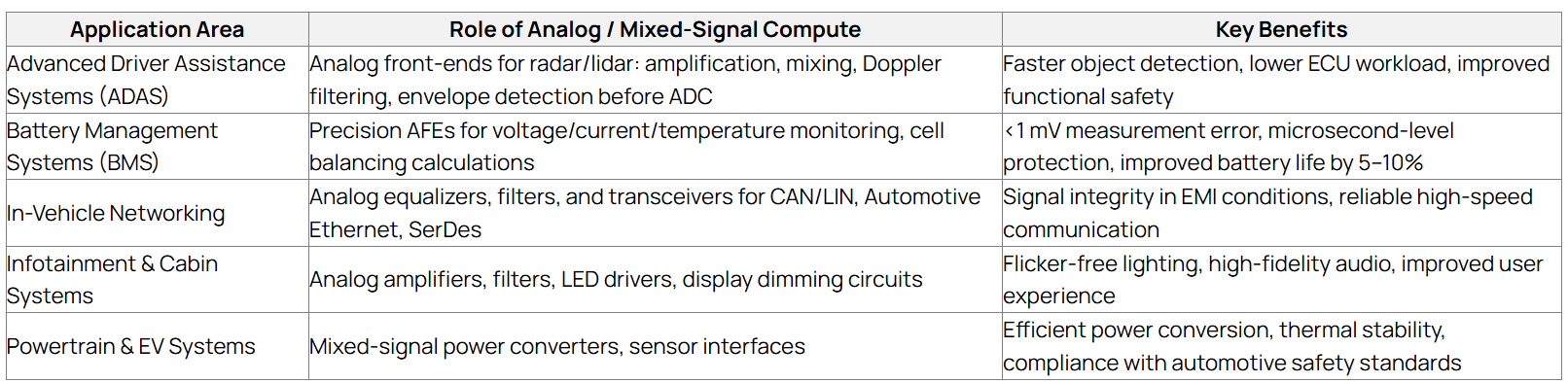
  • Ultra-low latency: By processing signals directly in the analog domain, close to where they are generated, analog compute dramatically reduces the time between sensing and action.
  • Energy efficiency: Analog computations can consume up to 10x less energy than equivalent digital operations.
  • Bandwidth reduction: Pre-filtering and feature extraction at the sensor can cut data transmission by 30–70%, lowering ECU load.
Article content

Real-World Examples of Analog Compute in Action

  • Tesla: Tesla’s Battery Management System uses precision analog front-ends to continuously monitor thousands of cells in real time. By using analog sensing and computation close to the battery pack, Tesla achieves sub-millisecond protection response, enabling adaptive charging profiles that extend battery life by several years and improve supercharging efficiency.
  • Toyota: Toyota’s hybrid control units leverage analog sensing circuits to measure current and voltage from the motor-generator and battery packs with very low latency. This enables seamless torque blending between ICE and electric drive, a key reason why Toyota hybrids deliver industry-leading fuel economy and smooth driving performance.
  • Volkswagen: In its Slovakia operations, Volkswagen uses mixed-signal control systems in intralogistics equipment. Analog controllers embedded in forklift drive systems improve motor efficiency and battery usage, contributing to ~20% higher productivity and ~10% less travel distance, translating to measurable operational savings.
  • Waymo & Cruise: These companies rely on low-latency analog radar front-ends to pre-process signals before feeding them to digital AI pipelines. By doing clutter rejection and Doppler filtering in the analog domain, they reduce digital workload and improve pedestrian/vehicle detection latency, a crucial factor for safety in dense urban driving scenarios

Example: Radar Signal Chain Optimization

To demonstrate the power of analog compute, consider a typical radar ECU design for autonomous driving. Traditional designs rely on wideband ADCs feeding heavy digital signal processing chains for clutter filtering. By integrating Analog compute front-end, key operations such as clutter rejection and Doppler pre-processing can be performed before digitization. This approach can deliver:

  • Up to 40% reduction in ECU power consumption
  • Up to 25% faster object detection latency
  • Up to 30% lower data bandwidth, allowing use of a smaller, lower-power DSP core

This optimization not only improves functional safety margins but also reduces thermal load and BOM cost.

Business Impact of Analog Compute

From a business perspective, analog compute directly translates to better ROI for automakers and suppliers. Reduced power consumption leads to smaller heat sinks, lower cooling costs, and lighter ECUs - all of which cut vehicle weight and BOM cost. The ability to shrink digital processing requirements can save up to 20–30% in ECU cost per vehicle. For EV manufacturers, improved efficiency translates into extended range, a powerful differentiator in a competitive market. Overall, analog compute helps OEMs launch safer, more feature-rich vehicles faster, while staying within strict cost and power budgets.

Safety Impact

Safety is non-negotiable in automotive design, and analog compute plays a critical role in meeting functional safety targets. Processing signals closer to the source reduces latency, which can mean several extra meters of stopping distance at highway speeds. Analog circuits also enable real-time fault monitoring, redundancy checks, and built-in self-test (BIST) capabilities that align with ISO 26262 ASIL-D requirements. This ensures that failures are detected early and mitigated before they can lead to hazardous events.

Benefits for Consumers

For the end user, analog compute means a more responsive, safer, and enjoyable driving experience. Drivers benefit from smoother ADAS interventions, faster emergency braking, and longer EV range. Passengers experience higher-quality audio, flicker-free lighting, and more reliable infotainment systems. Consumers also indirectly benefit from lower vehicle costs, as OEMs can pass along savings from more efficient, integrated electronics.

The Emerging Frontier: In-Memory and In-Sensor Compute

The next wave of innovation is analog in-memory compute (AiMC) and in-sensor compute. Crossbar-based AiMC can execute matrix-vector multiplications in O(1) time, offering 50–100x better performance-per-watt than conventional digital AI accelerators. For cameras, in-sensor compute can perform operations like Sobel edge detection or HDR compression before leaving the sensor, reducing bandwidth needs by up to 60%.

Conclusion

As vehicles evolve into high-performance, AI-driven machines, analog compute is no longer a niche, it is a necessity. By blending analog efficiency with digital intelligence, we can deliver safer, greener, and more responsive vehicles. At Vellex, we are proud to provide this analog intelligence revolution for the automotive world.

READ MORE

April 30, 2026

A Detailed Guide to Federated Learning on Edge Devices

Vedant Wakchaware
While on-device training secures user privacy, it unintentionally traps intelligence, forcing every edge device to learn the exact same lessons from scratch. How do we build a collaborative "hive mind" without exposing raw data to the cloud? The answer is Federated Learning. This comprehensive guide explores the decentralized paradigm of bringing the model to the data, detailing how devices evolve together by sharing abstract mathematical updates. Dive into the 5-step federated architecture loop and discover how cryptographic shields like Secure Aggregation and Differential Privacy prevent data extraction. Learn how advanced algorithms overcome severe bandwidth constraints and hardware disparities to power the next generation of secure, collective AI.
April 22, 2026

Decoding Weight Updates: How Edge AI Adapts Itself in Real-Time

Vedant Wakchaware
How does a disconnected smartwatch learn your unique music taste offline using just a fraction of the parameters found in massive cloud models? Step inside the mathematical core of on-device training as we decode the micro-weight update. This deep dive breaks down the exact sequence—from the initial Forward Pass and Loss Calculation to local Backpropagation—that enables edge hardware to dynamically adapt its logic in real-time. Discover how this highly targeted learning cleanly bypasses the SRAM memory wall, paving the way for truly autonomous, mathematically private, and incredibly efficient AI across all industries.
April 15, 2026

The Mechanics of On-Device Training: Hardware and Software Optimizations for the Edge

Vedant Wakchaware
Move beyond static AI inference. This comprehensive guide explores the mechanics of continuous on-device AI training, detailing how developers overcome severe hardware and memory bottlenecks. Discover how advanced software optimizations like sparse representations, layer-wise training, and federated learning allow edge devices to adapt, evolve, and learn locally in real-time, completely untethered from the cloud and without compromising user privacy.